Sunday, December 25, 2022
I Have A Bit Of Welsh In Me LOL
I had my DNA analysed a few years ago. They keep updating the results, which is an eye opener. Initially I was mainly English and Irish with a bit of Vioking in me. I was happy with that. Sadly over the years I have lost the Viking connection and gained a Welsh one. Not sure how I feel about that LOL. Less rape and pillage, more sheep and leeks.


Friday, December 16, 2022

Thursday, December 15, 2022
The Difficulties Of Getting An Agent
Getting an agent these days is difficult. I hesitate to use the word impossible, but for most first time writers I am sure it feels that way. In my experience, most agents lack even basic courtesy and don’t even reply to most writers who approach them. And it’s been that way for many years.
I wrote to five agents after I’d written my first thriller - more than thirty years ago - and not one even bothered to reply. Even when I had three books in print and was trying to get an agent for The Chinaman, only two agents out of six replied to my letter. If they won’t even reply to a published author and former Fleet Street journalist, what chance does a first-time writer have?
I get contacted regularly by frustrated writers who are simply being ignored by agents. I wrote to seven agents late in 2022 about a new novel I had written - only three replied. And I have sold millions of books! You’re just going to have to accept that getting an agent is no easy task, no matter how good a writer you are or how good your book is. I’m sorry, but that’s the cold hard truth of modern-day publishing.
Most agents these days have websites and on those websites they will explain their policy on submissions. When I first started you had to send a pristine typed manuscript. That's all changed, these days it’s all done by email. So send the manuscript, but bear in mind that you also have to sell yourself. You need to convince them that they need to read your work. If you’ve written a thriller, then push your military background if you have one. If you’ve written a book set in a school and you were a teacher, mention that. If you’ve written a crime novel and have spent time in prison, sell that. Push yourself as much as you push your book.
The Writers and Artists Year Book has a comprehensive list of agents in the UK, Ireland and the United States. Or you can Google ‘Literary agents who take submissions’. Write to them all. Every one. That’s the beauty of the new technologies, you can send a hundred emails as easily as one. Agents would prefer that you approach them one at at time, but as most don’t reply they have no right to ask that. Write to every agent you can. Dozens. Hundreds, if you want. Emails are free. If an agent really wants to represent you, he’s not going to care who else you approached.
In your email, promote yourself but flatter the agent. Find out who they represent and tell them what a great job they are doing for such-and-such a writer and that you think they’d be the perfect agent to handle your book. That’s how I got my first agent – I wrote Gerald Seymour’s agent a flattering letter and he took me on. He eventually sold The Chinaman and The Vets for a good six-figure sum. He went on to become an absolute nightmare - about which, more later!
Please don’t blame me if agents don’t write back. Most won’t even acknowledge receipt of your email. They can be very frustrating people to deal with. Just keep trying. Keep pushing. Work your contacts. Do you know anyone who works for an agency in any capacity? Did you go to school with someone who works for an agency? Start asking all your friends and relatives if they have any contacts. If it’s any comfort, the publishers I’ve spoken to all tell me the same thing – that if a book is good then it will be published eventually.
Don’t forget that every literary agency has several agents, so if one agent says no it’s still worth approaching other agents at the firm. Writing is very subjective, and what one agent hates another might love. So keep on trying!
If you are rejected by every agent in town then there are two possibilities – either your book isn’t very good, or the agents are just incompetent. Either is a real possibility. But it might be worth having a closer look at your work, and try to be objective. Maybe the brutal truth is that your book isn’t as good as you think it is. Maybe it needs a total rewrite or maybe you need to start a new book. I think anyone who actually finishes a book deserves a pat on the back for that alone, but just because a book has been written doesn’t mean that it’s publishable.
There was a time when publishers refused to look at unsolicited manuscripts. I came through the slush pile at Harper Collins, back in the days when publishers used to love trawling through piles of manuscripts.
What changed? Technology changed. I wrote my first novel on an old manual typewriter. It was bloody hard work. And if I made a mistake I had to retype a whole page. Rewrites were a nightmare! As a result, most would-be writers gave up. The process itself sorted out the wheat from the chaff. But then came computers and printers and writing a book became physically much easier. Anyone could write a book. And they did! And publishers were flooded with manuscripts, the vast majority of which were unpublishable. There was so little wheat and so much chaff that publishers shut down their slush piles and handed the selection process over to agents. Agents didn’t have the staff to deal with the tsunami of manuscripts, which is when the rot really set in. Agents abused their power as gatekeepers by simply ignoring most writers.
Nowadays publishers are looking at unsolicited manuscripts again so it is worth writing to editors. Just bear in mind that it is a long shot. Again, sell yourself and flatter them and maybe, just maybe, they might look at what you’ve written. But do bear in mind that your email might not get to the editor, it might be intercepted by an eager assistant. And don’t try phoning them – that is a total waste of time. Again, it is worth working any contacts you have. But don’t ask me or any other writer if we’ll read your work – we just don’t have the time and also won’t put ourselves in the position where we could be accused of plagiarism down the line! I know it’s frustrating, but the thing to remember is that nothing worth having comes easily.
One thing you must always remember is that agents are the middle-men in the publishing world. They are acting for writers (their clients) but the actual money comes from publishers. A writer has only one agent, but an agent has dozens, often hundreds, of writers, and will be dealing with all the major publishers. At the end of the day, an agent is not going to jeopardise his relationship with a publisher for the sake of one writer. Publishers are far more important to agents than writers are, and the writer is always going to come off worst in any conflict unless you have the clout that comes with being one of the really big sellers. That’s a sad fact of life, and all writers should remember it.
But, there’s no doubt that there are advantages in having a good agent in your corner. The agent can act as a buffer between you and your publisher, so that problems can be resolved without anyone taking it personally. It’s better to have a moan at your agent and let him or her negotiate with your publisher rather than you letting off steam yourself! And it’s definitely true that an agent is better placed to negotiate the financial arrangements – there’s more to a book deal than the advance, and often it’s in the small print that a good agent can really earn his commission. The trick is to find an agent who believes in you and who believes in your work.
The worst agents by far are those that I have come across in the States. Awful people. I had one who told me he didn’t think he could represent me ‘because I don’t think I would walk through walls for the book’. It was a stupid thing to say – a good agent is a salesman and a good salesman should be able to sell anything. I had another agent from a large agency grinning with pleasure when he told me that he wasn’t going to take me on. They seem to take pleasure in belittling writers, an attitude I’ve always been unable to understand.
So, my advice would be to get an agent if you can. Once you have a deal and the big money starts rolling in, watch your agent like a hawk and if they start to take you for granted, sack them and get another. Once you have a revenue stream on offer, you will suddenly find that they will reply to your emails! Most writers I’ve been are unhappy with their agents but few ever move. It’s like banks. People are reluctant to change banks but they should do so at the first sign of a problem. There are plenty of banks out there and there are plenty of agents.
Tuesday, November 24, 2020
My New Standalone - Available Next Year

Now available on Amazon - https://www.amazon.co.uk/Hunting-explosive-thriller-bestselling-Shepherd-ebook/dp/B08784ZPYB/
Saturday, November 21, 2020
An Agent Running In The Field
When I was in my twenties and wanted to be a writer, I read pretty much everything by Jack Higgins, Len Deighton and Gerald Seymour. And the more I read, the more I began to think that if I worked hard enough and learned the craft, that I might one day be able to write the sort of books that they write. But I also read everything by John Le Carre, and the more I read of his work, the more I realised I would never be as good a writer as he is.
Now, forty years later, I like to think that I am just about in the same league as Jack Higgins, Len Deighton and Gerald Seymour. But when I pick up a new Le Carre, I’m always brought back to earth. After some thirty years earning my living as a thriller writer, I can see that I will never be as good a writer as the master..
I’ve just finished reading Le Carre’s latest - Agent Running In The Field - and wanted talk about it. (SPOILER ALERT - If you haven’t read it and think you might, don’t read any further as I will talk about the plot and the ending!)
It’s a great read, I stormed through it in a few days and read it late into the night. The writing is, as always, superb, and the characterisation is awesome, as are his descriptions of people and places. He writes at a totally different level to me. I’m not worthy.
So what I am posting about it? It’s not by way of criticism, it’s more a case of trying to get my thoughts in order and to see what everyone else thinks.
Here’s one thing that troubled me. Everyone in the book is rabidly anti-Trump and anti-Brexit. Everyone. There is no balance. Now, I’m not necessarily a fan of balance. My editor asked me to put in a favourable Somali person in my thriller about Somalian pirates, and I did understand and agreed even though I felt it wasn’t necessary. And generally I have Spider Shepherd to provide a more balanced view when faced with characters spouting extremist opinions be they right, left, racist or homophobic. But there is no one in this book to provide an opposing view. I just felt it was tiring being constantly told that only idiots supported Trump or wanted to leave the EU. And it felt to me that if you write like that you risk alienating half your readers!
The other issue I had was the plot. The ending made absolutely no sense to me. The hero - Nat- and his wife, help the would-be traitor Ed escape with his new wife, Flo. They sneak him out of a building and into a car they have rented and drive him to an airport. The idea is that Ed and Flo run away to start a new life somewhere in Europe. Wait, what? They have no money, no fake documents, how exactly are they going to do that? Fifty years ago it might have been possible to start a new life as easily as that, but these days? And Nat has openly helped a would-be traitor to escape. That means he and his wife are headed for prison. There’s no thought of what the repercussions will be. And would Ed’s alternative, of staying in place and becoming a double agent, be so bad? A few years of that and he could leave and start a new life with the blessing of the UK authorities. I really didn’t understand the ending. Or was I missing something? If you have read it, please let me know what you think!
But it was the tradecraft, I think, that worried me the most. In his early books I loved the operating secrets that he revealed, dead drop letter boxes, secret meetings, counter-surveillance measures, I always felt that he was telling me stuff that I really wasn’t supposed to know. But in this latest book, most of the tradecraft seems to be stuck back in the Seventies. Do agents still put secret papers in hollowed-out handles of badminton rackets? Do foreign spies still receive coded messages using one-off code pads? Do they listen to overseas radio stations to get their coded instructions? At one point Nat is wary of the phone extension in his bedroom. But he is happily carrying around a mobile that his bosses have given him. Doesn’t he realise that even when switched off it is capable of storing and transmitting everything heard in its vicinity? Doesn’t he know that lasers can pick up vibrations on his window and turn that into sound? The bedroom landline is the least of his worries.
He wants to contact a former spy and his way of contacting her is to write a note, sneak into her building, pop it through the letterbox and knock and run away. He then waits for her to join him on a bench. But he didn’t even know if she was home.
It was all very strange, as if spies from the 60s and 70s had been transplanted to the present day and who ignored all the technological advance that have been made over the decades. These days a landline is the last place you’d put a bug, and encrypted mobiles and websites are a safe way of communicating generally. A burner smart phone and a few WhatsApp accounts will do the job…..
Anyway, I did love the book, it entertained me and made me think, so job done. I’d love to hear any other opinions on it!

Thursday, July 18, 2019
Promoting A Book With Sockpuppets - Is It Wrong?
There is a school of thought that says writers shouldn't use sock puppets to promote their work. Me, I am ambivalent. I think this works.
Friday, August 3, 2018
A Sunday Times Bestseller
The new Spider Shepherd thriller Tall Order is now out and made it into the Sunday Times best-seller list. How cool is that?

You can buy Tall Order BY CLICKING HERE
At the moment I'm hard at work on a new standalone thriller - LAST MAN STANDING - and then I'll be starting on the Spider Shepherd book for 2019. Busy, busy, busy!
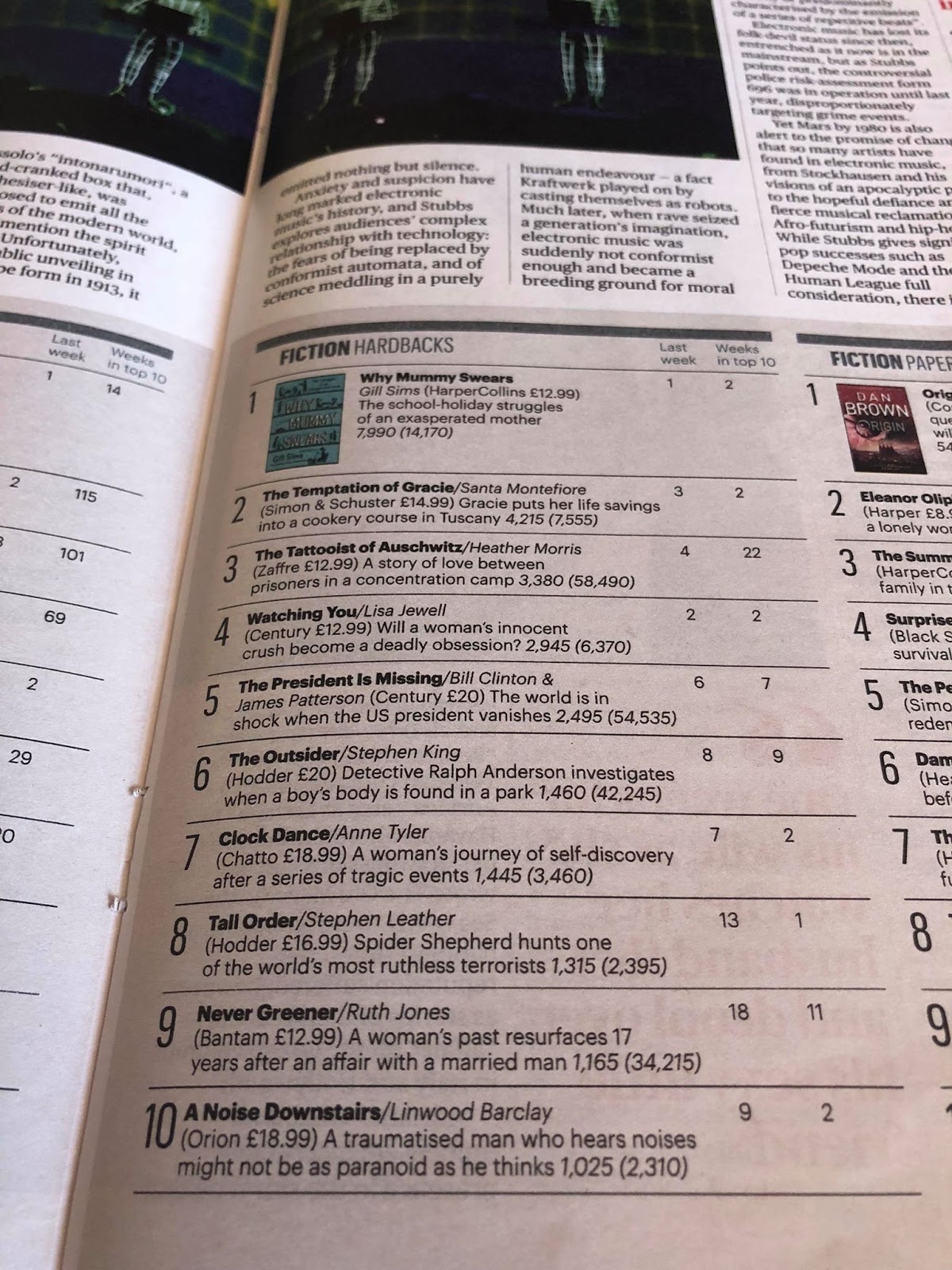
You can buy Tall Order BY CLICKING HERE
At the moment I'm hard at work on a new standalone thriller - LAST MAN STANDING - and then I'll be starting on the Spider Shepherd book for 2019. Busy, busy, busy!
Subscribe to:
Posts (Atom)